Louis Sullivan
A Pioneer of American Architecture
Louis Sullivan was one of America’s most influential architects.
Born in Boston in 1856, Sullivan moved to Chicago as a young man and became one of the leading figures of the Chicago School of Architecture. He helped develop new approaches to designing tall buildings during a time when Chicago’s skyline was rapidly changing.
“Form Follows Function”
Sullivan believed that architecture should express a building’s purpose rather than simply imitate older styles. His famous principle, “form follows function,” became one of the defining ideas of modern architecture. He believed that tall buildings could have their own distinctive identity, combining innovative structure with carefully designed ornament.
Sullivan’s Chicago Legacy
Sullivan designed some of Chicago’s most important buildings, including the Auditorium Building, the Carson Pirie Scott department store, and the Charnley House. His work combined new structural ideas with distinctive decorative details, creating buildings that were both practical and beautiful.
His influence extended beyond his own buildings. A young Frank Lloyd Wright worked in Sullivan’s office early in his career and later acknowledged Sullivan as an important influence on his own architectural development.
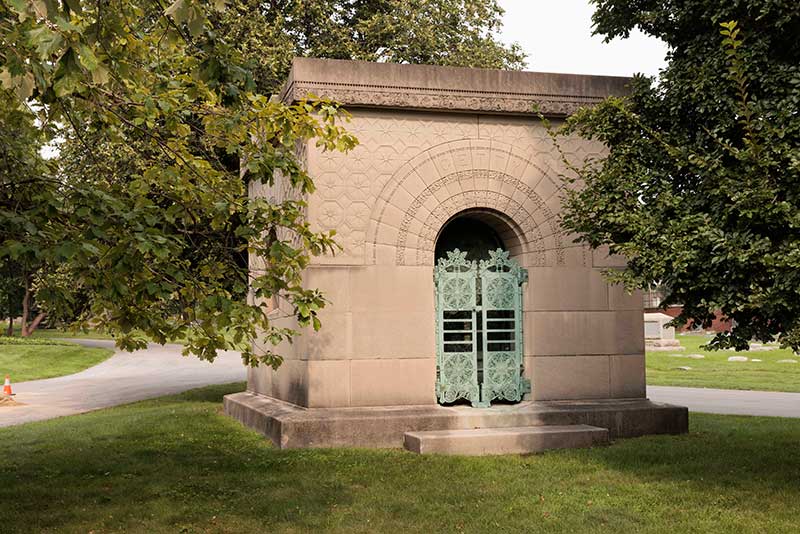
Getty Tomb Design
Sullivan also left his mark on Graceland Cemetery. He designed the Getty Tomb and the Ryerson Tomb, two remarkable monuments that demonstrate his ability to bring architecture and art together. Their strong geometric forms and intricate ornament reflect the distinctive style that made Sullivan famous.
Death
Sullivan died in 1924 and was initially buried with a simple marker at his parents’ gravesite. A more distinctive memorial was later created by architect Thomas Tallmadge, featuring Sullivan’s profile and design elements inspired by his architectural language. He is buried in the Lakeside Section, Lot/Pathway 105, Space 3.